Playing around with some of my experiments I realized that someone else was doing something similar is it the same thing that remains to be seen, but let's first look at the experiment
For those who watch the entire experiment you should understand the phenomenon happens but the next video is a demonstration of perhaps the same thing we do not know. But it seems that he is getting similar results
Is this due to the graphite in size of capacitor can anyone really explain what's going on here.
It's time to put some new series on the board
Now that we understand some of the things that the scientists are looking for it gives you a basis to construct your ideas from. Let's go back and understand what he is doing by adding two more videos made from two different people and see if there's any similarities or something that we can make new entirely.
Similar to the Piezoelectricity effects when you strike Crystal In the videos above a constant pressure also causes this same effect I believe it's worth investigating see if you can put this crystals between two neodymium magnets which keeps a constant pressure on such crystals as the crystal battery then you've made a pressurized Crystal battery that should last years constantly running. Think about it let's expend this experiment
It's not a complicated motor at all it's just that it's been hidden away, and we've been taught that it's impossible so don't even think about it. This is what you will have to overcome I want you to actually think about it quite hard. Because once you do it's easy to see what they've been hiding. I'll try to break it down as far as we can with other people's documented research
After looking at this video you must picture that diagram of the bill system right besides that wooden spinning wheel it would be designed to push the button up and down instead of your finger which is shown in the video. How much energy would it take to create a magnet to turn off and on and push the apparatus we see in video. What happens if we take the weight off the apparatus he's pushing up and down and turning into plastic neodymium magnets are very light compared to ceramic magnets. So if we decrease the weight how much energy would it take to get a electromagnet to push it up and down let's study other forms of electromagnetic Motors in the energy it takes to move the spinning wheel.
This is a video of the first prototype motor that I built in 2005. The motor was built for under $100, wood
frame, half inch by 1 inch by 4 rare earth magnets and a 30 year old subwoofer I used for the reciprocating
action. The video was shot in 2005
The opinion of media library we believe that his latest models not shown took them this motor Concept in another Direction oh, he was so close to understanding the precipitation was the key with a wide enough will calling the torque you could turn a generator head from a 4000 Watt gas generator. And use the power of the magnets to do so so, as you can see pushing the magnet back and forth takes little energy compared to 4000 Watts of power that it will generate.
Let's take a closer look
Now you understand that this can be done if manually what happens if we switch over to electronics components and electromagnets how much power does it take to run electromagnets
As you can see it doesn't take much power to move the wheel.
Let's imagine that we take a Tesla car, and take the motor out of it and attach a generator head from an old Generator to it. The power produced by those powerful Motors should not only drive that generator head since the generator heads has Farm or less energy conceptions then an actual car. What we're trying to say is the weight of the car and you inside the car if not put on just the generator head so we just overpowered the system oh, so now what we need to know is how much battery power will it consume for running this engine and how long to determine the alternators size, we don't have to worry about the demand on alternator because it's only job is to run the electromagnet. The electromagnets and the permanent magnets react to each other and do all the actual powering of the system. And as you can see with the smaller version of this representation it wouldn't take much at all to run the electromagnets so where does all the power come from. Leverage how big the wheel is the bigger the wheel the more torque you have or power.
Here's a simple diagram and only a representative of what we're trying to do look at the arrow that goes from the alternating or generator which only job is to make power for the electromagnets.
Ladies and gentlemen the electro-magnets run every motor known two man even the gas-powered ones believe it or not. Once you understand what Tesla was trying to tell you this diagram should tell you everything else you need to know if the configuration go back to part 1 of this and see the simple diagrams to get the understanding on how these motors operate then look at this picture again below.
So how will you do your own example, try taking a little toy motor which will act as your alternator this will replace the 1.5 batteries for your electromagnets you may have to put a capacitor in between as a bridge. But it's just a simple little motor with a reed switch nothing complex if it has enough torque due to its powerful magnets it will turn that motor and produce electricity for your capacitor
Now learn a few capacitor tricks and adding jewel thief and you have a self running generator.
But some of you will say that this little motor will not powerful enough to run a generator
Let's look at another design taking from the same motor company, is these motors powerful enough to run a generator
Yes it's enough power to run a 3 volt LED lights, now add your electrical component, the jewel thief in an alternating capacitor switch and you have yourself a little self running generator.
so where do we get our motors from
Let's do one more examples to wrap this all up, let's run a motor off a capacitor
In this demonstration you'll have to find out why the capacitor is not charging, (we'll talk more about this later cuz we don't believe that's true) you find out the little tricks of switching or would we call impedance then you definitely have what it takes to make your own self running generator.
After watching the above videos you should come to the conclusion that you can run these motors off of a capacitor and get a step-up boost. One of the things we've been talkin all through this paper can you do this very thing. It doesn't break the laws of physics it runs on stored energy in the first place so now you know it's possible, so why the negativity from him because he didn't have but one capacitor and capacitors can't charge and discharge at the exact same time. What you would have to do it have two capacitors and a switch which, switches between one another. That means one capacitor is charging and the other is running the motor and that 12 boat motor is enough to charge those supercapacitors even at the same time it's called a time delay or a flip-flop circuit. ( two examples; https://youtu.be/zXu6o39ut44https://youtu.be/_6_JKemTKzo yes for every problem we have a solution but let's talk about why that guy's capacitor wasn't charging in his video, yet he never showed how long the motor will run which is our very point. If the video shows this apparatus will run for an indefinite time it will be great for emergencies so what's the point where the energy comes from. Keep in mind that these problems have already been solved by Nikola Tesla, but JP Morgan and Edison always sought to make money over giving someone something free. So for all these years we've been using Edison's design instead of Tesla's. That's right all Motors and all applications today uses Edison Motors not Tesla's, why is that because you have to buy all those Motors with Tesla kids would continue to run most of you would be off the grid or have a significantly Bill drop.
Now we just stated that you cannot charge the capacitor at the same time you are using the energy we're going to make a rebuttal to what we've been told and here it is video below
When we were told this about the cap we had to make this video, believe me a lot of people out there or trying to always tell us that there's no such thing is a self running generator, we are stating that if the motor supplies the energy that is consumed by the same apparatus then it is self running. Some people out there may disagree and says the energy is coming from the capacitor, we're not going to argue that point the point is the project Works continuously so we achieved what we set out to do and this will work for bigger Motors 2 so remember how we and media library test our information against what people say and what we are actually going with.
We live in the 20th century these things that people think it's so hard to do have already been accomplished long ago, we don't see him because of capitalism. We want you to understand that every one of these magnetic motors have to use a small amount of electricity, send electricity is used more efficiently so the electricity can keep up with the demands of the motor itself. There's the big secret about magnetic motors, magnets hold their own energy source we're just manipulating it to our advantage to more powerful the magnets the bigger the motor can be electromagnets is just switching electrical charge from one circuit over to another, how far do you believe we can pass that same voltage through a motor Tesla did it with his synchronized motor the current runs through a wire and the rotor follows it like a Little Lamb. (motor windings' current in synchronism with follow the current). Types of motor
Electrically excited DC motor.
Permanent magnet DC motor.
Brushless DC motor.
Switched reluctance motor.
Cage and wound rotor induction motor.
Torque motor.
Ironless or coreless rotor motor.
Isn't it funny that we haven't came up with anything new no new circuit score any new gadgets in the electrical motor division into Tesla Motor
This is a simple little device with a simple little answer, what we're trying to prove is that you can make a Off the Grid motor using the same principles as you seen above video. But what do you actually need to accomplish this, one you need a sensor to you need a bell system see diagram below
Look at the diagram above and simply remove the bell and replace it with Calloway's magnetic motor and add a magnet onto the hammer that used to ring the bell, the sensor tells the electromagnet when to turn off and on let's look at one more video to see this in action
The switch was on 4.5 votes from DC
Once you understand being simple little terms then you can create a bigger and more powerful motor they even uses less electricity than the big gigantic Gadget to move a lightweight neodymium magnets was just over power. But none the less the concept has been proven now it's up to you to improve upon this technology like we had. Hope to see your YouTube video explaining how you improve this simple little magnetic motor.
Here's a hint in a clue
Try adding a capacitor and a
generator onto the rotating motor axel
Here's an old paper we were talking about earlier, you may go to the previous link here
are related in one big happy family, why don't people want you to know this? because If you notice in the video examples above they were getting free energy as they lit up those light bulbs. It wouldn't take long for people to realize that passing electricity through a certain circuits or coils would produce a field of free + a magnetic field at the same time, so 1 actually equals 2 in this case,
For years people have try to make this mechanical arm move back and forth to move the magnets, they use their own hands to perform this and it and (as you can see it does work) but today we have circuits which will turn on and off electromagnets to do the same thing why do they make this simple little things so hard. Go back to the (diagram below) and see the coil electromagnetic which turns off and on, again it's Tesla's work and it doesn't take energy to turn a switch off and on or switch back and forth just moving your energy you already made from one place to the other and using the very energy doing work to work in your benefit all on magnetic force.
So let's finish this so you understand what they've been trying to stop for so long if you build any magnetic motor that also is coupled with a generator, you have a motor that will run indefinitely.
Why?
As the electricity from the generator runs down the wire, you coil the wire at sometime creating a magnetic field, the magnetic wheel larger than the motor, (for torque purposes). Will want to move away from the negative iron in The Wire. Just as the light bulbs lit up, the same effect what happens when you put magnets next to an electromagnet, it wants to move away from it's like polls.
See diagram below
When you start to bring all these things together as one, seeing that people can generate electricity from the electromagnetic fields that they Powerline gives off. And then scene that you can build an electric static motor that works off those same fields, then the diagram above seems to work. But when you look at reality Tesla's induction motor it puts those principles right in two practice. All Motors work on electromagnets
👌 what other evidence would you need to know that this diagram you see above works perfectly from all the evidence you have here, these motors are being used in the military applications for underground bunkers and is not previous to public examination. Meaning you will never be told about this type of device it's a military Secret. But not unknown if you study long enough in any Library.
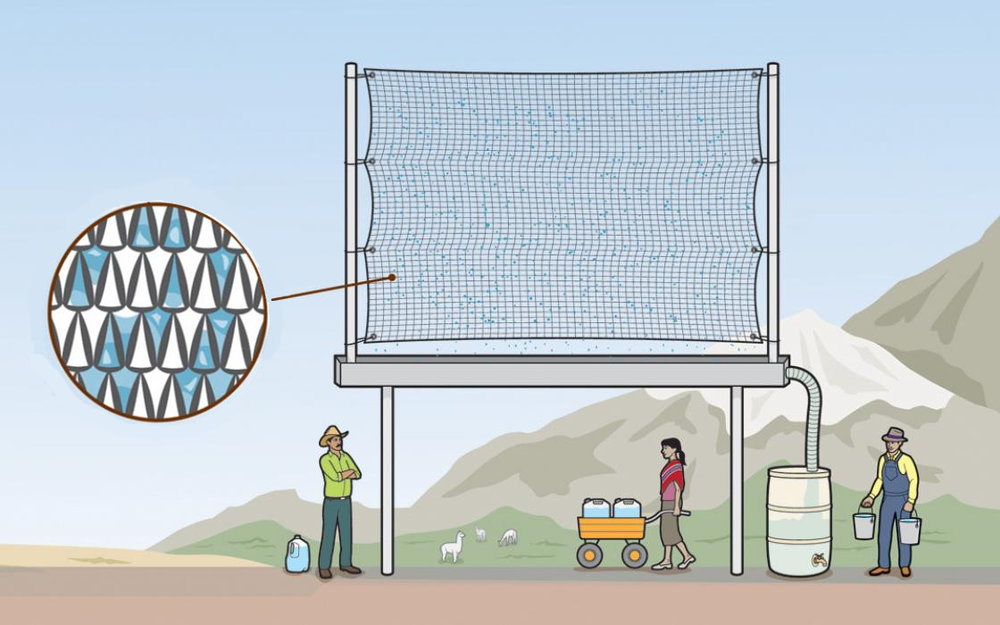
With the expected population increase in mind and its growing concentration in the cities, a team of experts has designed AquaWeb; a system to capture water from rain and moisture, and manage it efficiently in urban crops, the evolution of the classic fog-trap. The secret to the success of innovation, keep in mind we took this from a Spanish site and sometimes words are conveyed in different ways we're pretty sure that they're not actually catching frogs but took the inspiration from frogs and called it a frog trap
With the expected population increase in mind and its growing concentration in the cities, a team of experts has designed AquaWeb; a system to capture water from rain and moisture, and manage it efficiently in urban crops, the evolution of the classic fog-trap. The secret to the success of innovation,
Lima is the second driest city on the planet, its annual rainfall does not exceed 10 mm. The lack of water, as in most cases, is especially suffered by the poorest communities and families. About 1 million families in Lima do not have access to running water, in all of Peru there may be 10 million.
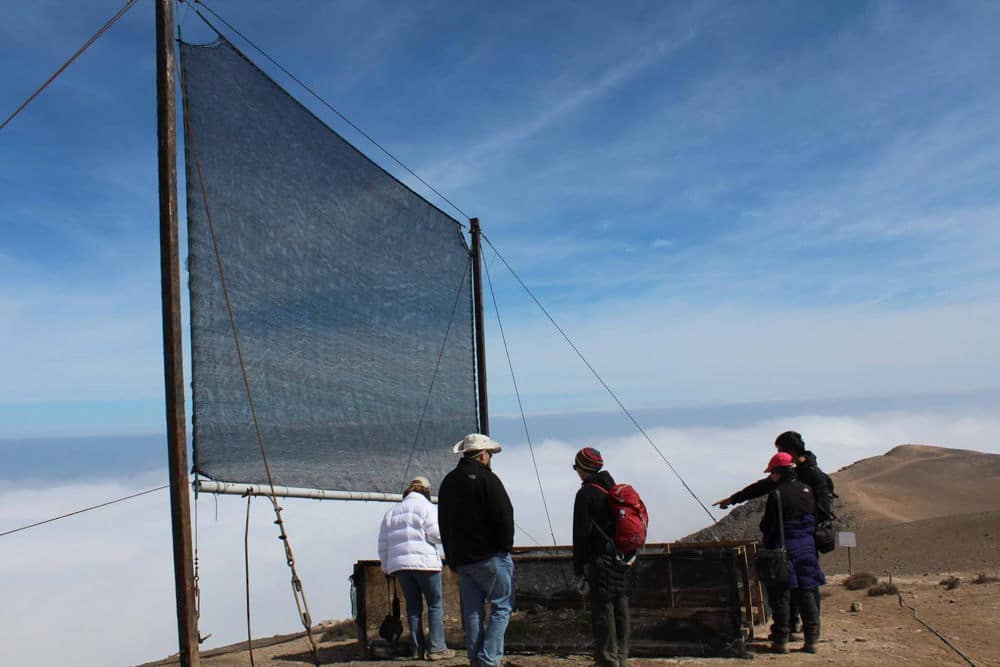
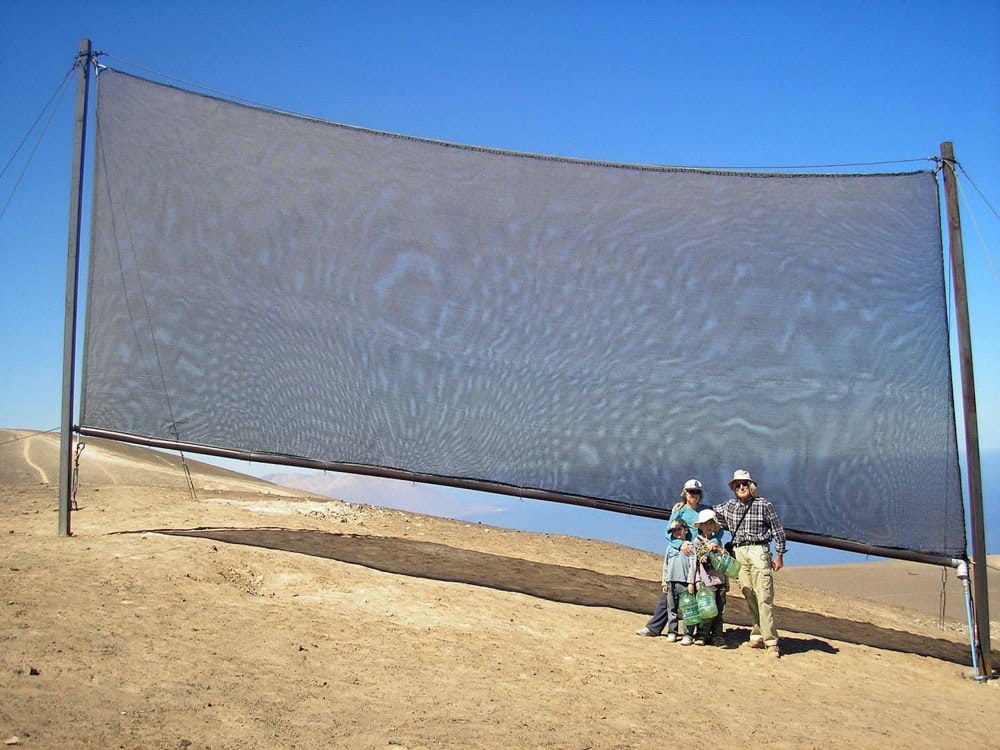
In the absence of "official" solutions, some began to look for alternative solutions. And this was the case of the Peruvian Engineer Abel Cruz Gutiérrez, who 14 years ago found a very clever solution to alleviate, as far as possible, the problem of lack of water. The solution is to catch the fog with its fog catchers, trapping the water drop by drop.
The idea is that the small drops of fog remain attached, thanks to the wind, in the nylon threads of the meshes (6 x 4 m) and then redirect them and accumulate them in tanks thanks to gravity. A system with which you can capture up to 350 liters of water daily. This water, although it is not suitable for human consumption, if it can be used for domestic tasks and cleaning, cleaning and irrigation.
awarded with the Ray of Hope 2017 , is that it has taken its inspiration from nature, specifically bees, spiders, fungi and plants.
To shape a system that was suitable for urban producers and,The water of the fog catchers has allowed many families to survive thanks to agriculture.
The next step of Cruz is to be able to make the water of the catwalks drinkable and that the meshes can work all year round.
In addition to Peru, fog catchers are also used in Chile, in addition to other countries that are currently experiencing their use.
Clouds in the sky are not lacking. therefore, fully adaptable and self-sufficient, NexLoop looked naturally for the answers it needed. With this, when asked how to freely capture the water present in the atmosphere, the team focused on how spiders weave cobwebs that absorb water from fog .
After replicating this natural mechanism in its design, the next step of the team led by Jacob Russo, Anamarija Frankic and C. Mike Lindsey was to respond to how to store the water captured passively. For this, in this case the inspiration came from plants more resistant to drought , such as the ground anemone, scientifically known as Mesembryanthemum crystallinum, from which they learned how to retain water to survive in the most arid conditions.
Moving forward with its innovation, another issue that the team had to solve was how to distribute the water once captured. Again, nature illustrated them. Specifically, in this case it was the mycorrhizal fungi that helped to continue shaping the system, given its importance to transport water and nutrients and contribute them to the nearby species that need them.
With all the above, to close AquaWeb's design, it was only necessary to find the solid structure that would give shape to the whole. And at this point it was the bees that gave the solution, since the system took as a model the hexagonal structures of honeycombs , both for their efficiency and for their modular design.
Thus, with these sources, the result has been a system that will allow urban producers to save energyand be much more resistant to any unforeseen event. Specially designed to provide water to urban growing areas, such as greenhouses, vertical gardens or production areas in containers, AquaWeb aims to respond to a challenge of great magnitude: that it is possible to guarantee food to a growing and increasingly concentrated population in cities.
Thus, the design and development of this system is based on forecasts such as the following: it is estimated that the population of the earth will rise to 9,000 million people in 2050, year in which, in addition, 7 out of 10 will reside in urban areas . How to produce safe and sufficient food in cities? And this is precisely the doubt that this team tries to alleviate with AquaWeb, which, according to its slogan, will provide "renewable water for sustainable food" . This is also closely related to atmospheric water trapping using salt to attract water. 1 video example; https://youtu.be/z36jMKk-AdQ
This technology was never new in August 1954 they were developing and using this technology, now the reports which you will see below of a car that works in a similar way to a hydrogen fuel cell, however, the liquid used for storing energy is saltwater. We also see on YouTube that saltwater batteries are commercialized.
You will also see the Mist information that they spooked out as we proved once again that these apparatuses are a thing of the past and have already been developed and used. Of course some of these projects are used and Military applications so therefore cannot be given to the public. I guess most of you who are reading this must figure out the same thing I have for a long time let's see the proof. BOAT RUNS ON SEA WATER
Free, unlimited electric power from the salty sea may soon replace gas, diesel engines in marine use.
EVERY so often someone comes up with an idea so simple and apparent that millions of Monday-morning quarterbacks promptly kick themselves and mutter “Now why didn’t I think of that?” Occasionally the idea is completely original. Usually, however, it is an old chestnut that has been kicked around until some bright lad finally dopes out a way to make it work. Ralph E. McCabe, designer and patentee of a practical, new salt water battery, does not claim to be the first to conceive the notion of extracting electric current from the ocean brine. He does claim to be the first to produce a seagoing wet cell that will pull enough juice from Davy Jones’ locker to run a boat and haul a payload!
McCabe’s battery is the result of no sudden stroke of genius. Since he first latched on to the basic idea back in 1948, he has slowly and painfully developed it to its present state of efficiency. During that time no less than 36 model boats have been built and tested at various points in the Atlantic, Pacific and the Gulf of Mexico. His latest models, Mamie and the Eighth Wonder of the World, are each 21 in. long with a 4-1/2 in. beam and they weigh 2-1/2 and 3 lbs. respectively. Each produces a little over one volt and up to three amperes of current, enough to drive them through the water at speeds up to five mph. This, as any boatman can tell you, is quite impressive for a working model of that size. In addition to the propulsion motors, some of the models are fitted with electric fights, foghorns, etc., all operated from the same basic power source.
The theory behind McCabe’s power plant is simply that of the familiar wet battery. The salt water of the sea acts as a conductor of the electric current flowing between a carbon-graphite positive plate and a nickel-zinc negative plate. This current operates a D. C. electric motor which, in turn, drives the boat’s propeller. The plates are corrugated or grooved to provide increased working area without increasing their overall dimensions.
Some of McCabe’s earlier models stalled after a short run due to the polarization or “balancing” of the ions. Eventually this difficulty was overcome and his latest boats have ticked along steadily until the motor brushes or armatures became dirty—a running time of five-and-a-half hours and a distance of some 20 miles. After cleaning they promptly took off again as strong as ever. With stand-by motors and facilities for automatic changeover, there is no reason why such a power plant should not run indefinitely.
McCabe has applied his boat-battery principles to a newly patented flashlight cell which he hopes to have on the market this year. Circular in section, it embodies a grooved carbon-graphite positive rod in the center surrounded by a cylindrical, zinc negative plate, deeply corrugated for increased area. He states that this new arrangement produces twice the amperage of the present cell of similar size and lasts twice as long.
The dry cell set-up, shown in the diagrammatic insert in the lead illustration, suggests an efficient wet battery arrangement suitable for large, seagoing freight and passenger ships. Encased in long tubes stretching fore and aft between the longitudinal bottom members of the conventional double hull, the batteries „ would occupy the space now used for fuel-oil tanks. Subsurface intakes on either side of the bow admit seawater to the battery tubes in a through-flow system that exhausts it from exit vents beneath the stern. The moving water, with its constant saline content, forms a perfect electrical conductor. The current thus generated is fed into banks of storage batteries from whence it can be drawn in an even, steady supply to operate the ship’s propulsive motors and auxiliaries. Such a power plant can be controlled directly from the bridge with no engine room telegraph ‘ necessary. The D.C. motors are instantly reversible under full loads, eliminating heavy reversing gear and increasing the vessel’s maneuverability.
Assembled in short, quickly detachable sections, the battery tubes are easily accessible for cleaning, repair or replacement of worn electrodes. Individual pumps and gate valves, fore and aft, permit any particular battery to be closed off and drained without affecting the others. With a few extra units built in for reserve power, the ship can proceed at normal cruising speed while repairs are completed. At the voyage’s end, plates can be readily pulled and replaced without the necessity of dry-docking the ship.
Similar sea-water battery arrangements can be adapted to small pleasure craft. As shown in the diagram atop page 86, they can be hung in sheet form on either side of a sailing yacht’s keel or spread horizontally across the flatter bottoms of motor cruisers. While the original investment in generating and storage batteries, motors and wiring would undoubtedly equal or exceed the cost of an internal combustion engine with its exhaust pipes, plumbing, tanks, etc., the elimination of dangerous and expensive fuels, engine vibration, noise and mechanical reversing gear would make it well worth while in the long run. It would certainly be far simpler, more easily controlled, lighter and more dependable than today’s cranky power plants.
McCabe feels that while he has developed his sea-water battery to a fairly efficient stage there is still plenty of room for improvement. He hopes, therefore, that some of you MI readers will pick up the ball and carry it a few yards further, “as the amateurs did in the radio field.” With this in mind he offers a free permit to use his improvements in advanced experimentation and will be glad to discuss plans and procedures with any interested amateur. His ideas, however, are patented and can not be used commercially without specific permission.
To encourage their continued development, McCabe plans a series of sea-water-powered boat races late this summer. He explains that initial battery experiments can easily be conducted in the family bathtub if two or three per cent of salt is added to the water.
The basic idea seems perfectly valid and you may get in on the development of a brand new form of marine propulsion—free electric power from the seven salty seas!
The sports car that runs on SALTWATER: Vehicle goes from 0 to 60mph in 2.8 seconds - and has just been approved for EU roads
Quant e-Sportlimousine's top speed is 217mph - equal to a McLaren P1
The car uses a saltwater flow cell system to power four electric motors
Water passes through membrane in tanks creating an electric charge
Two 200-litre water tanks can provide a range of 373 miles (600km)
The four-seater is 5.25 metres (0.4ft) long and 2.2 metres wide (7.2ft)
Price and sale date yet to be confirmed, but may cost more than £1m
Sports cars may not have the best reputation for being environmentally-friendly, but this sleek machine has been designed to reach 217.5 mph (350 km/h) – using nothing but saltwater.
Its radical drive system allows the 5,070lbs (2,300kg) Quant e-Sportlimousine to reach 0-60 mph (100 km/h) in 2.8 seconds, making it as fast as the McLaren P1.
After making its debut at the 2014 Geneva Motor Show in March, the saltwater technology has now been certified for use on European roads.
Scroll down for video
+6
Sports cars may not have the best reputation for being environmentally-friendly.But this sleek machine has been designed to reach an impressive 217.5 mph (350 km/h) – using nothing but saltwater
The 920 horsepower (680 kW) Quant e-Sportlimousine uses something known as an electrolyte flow cell power system to power four electric motors within the car.
It works in a similar way to a hydrogen fuel cell, however, the liquid used for storing energy is saltwater.
The liquid passes through a membrane in between the two tanks, creating an electric charge. This electricity is then stored and distributed by super capacitors.
+6
Its drive system allows the 5,070lbs (2,300kg) Quant e-Sportlimousine to reach 0-60 mph (100 km/h) in 2.8s
After making its debut at the 2014 Geneva Motor Show (pictured) in March, the saltwater technology has now been certified for use on European roads. The car carries the water in two 200-litre tanks, which in one sitting will allow drivers to travel up to 373 miles (600km)
+6
The car carries the water in two 200-litre tanks, which provide a range of up to 373 miles (600km). Inside is a full-length interactive dash, with wood-theme features and an Android-based entertainment system
The car carries the water in two 200-litre tanks, which in one sitting will allow drivers to travel up to 373 miles (600km).
Overall, the four-seater is 5.25 metres (0.4ft) long, 2.2 metres wide (7.2ft), the 1.35 metre (4.4ft).
QUANT E-SPORTLIMOUSINE
Four-seater car is 5.25 metres (0.4ft) long, 2.2 metres wide (7.2ft), the 1.35 metre (4.4ft).
Its 22-inch wheels sit just beneath impressive double gull-wing doors.
The 920 horsepower (680 kW) Quant e-Sportlimousine uses an electrolyte flow cell.
It works like a hydrogen fuel cell, however, the liquid used for storing energy is salt water.
The liquid passes through a membrane in between the two tanks, creating an electric charge.
The 5,070lbs (2,300kg) car has a top speed of 217.5 mph (350 km/h) and reaches each 0-62 mph (100 km/h) in 2.8 seconds.
Its 22-inch wheels sit just beneath double gull-wing doors which feature 'Chrystal Lake Blue' paint.
Inside is a full-length interactive dash, with wood-theme features and an Android-based entertainment system.
No price or sale date has yet been revealed, but some experts suggest it could cost more than £1 million ($1.7 million)
NanoFlowcell AG, a Lichtenstein-based company behind the drive, is now planning to test the car on public roads in Germany and elsewhere in Europe as the company prepares for series production.
It claims the technology offers five times the energy capacity of lithium-ion batteries of the same weight.
'We've got major plans, and not just within the automobile industry,' says NanoFlowcell AG Chairman of the Board Professor Jens-Peter Ellermann.
'The potential of the NanoFlowcell is much greater, especially in terms of domestic energy supplies as well as in maritime, rail and aviation technology.'
Video playing bottom right...
Loaded: 0%
Progress: 0%
0:00
Play
Mute
Current Time0:00
/
Duration Time1:41
Fullscreen
ExpandClose
+6
NanoFlowcell AG, a Lichtenstein-based company behind the drive, is now planning to test the car on public roads in Germany and elsewhere Europe as the company prepares for series production
+6
The saltwater technology offers five times the energy capacity of lithium-ion batteries of the same weight
+6
'We've got major plans, and not just within the automobile industry,' says NanoFlowcell AG Chairman of the Board Professor Jens-Peter Ellermann. 'The potential of the NanoFlowcell is much greater, especially in terms of domestic energy supplies as well as in maritime, rail and aviation technology'